Project details
- Client
- High Peak Theatre Trust Limited (Buxton Opera House) and 6 The Square Tea Rooms Limited
- Location
- Buxton, Derbyshire
- Sector
- Heritage
- Building
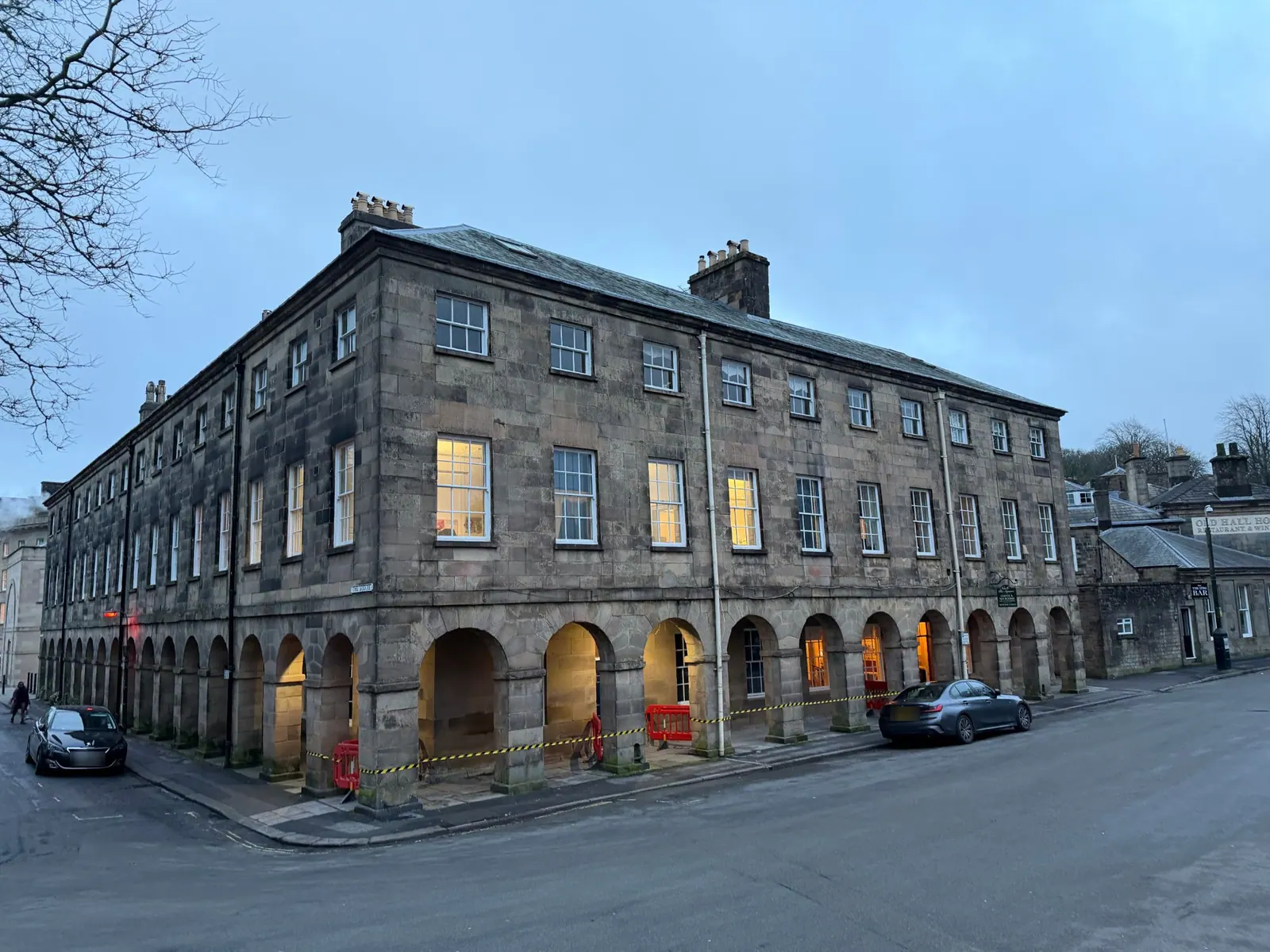
- Nos 5 and 6 The Square, part of a Grade II* listed late Georgian terrace designed by John White and built between 1803 and 1806, within the Buxton Town Centre Conservation Area.
Brief
Walker Wood was appointed to survey Nos 5 and 6 The Square, to establish the cause of long-standing movement in the arcaded front elevation, and to take a programme of conservation-led structural and fabric repairs through Listed Building Consent, tender and contract administration on site.
Project Summary
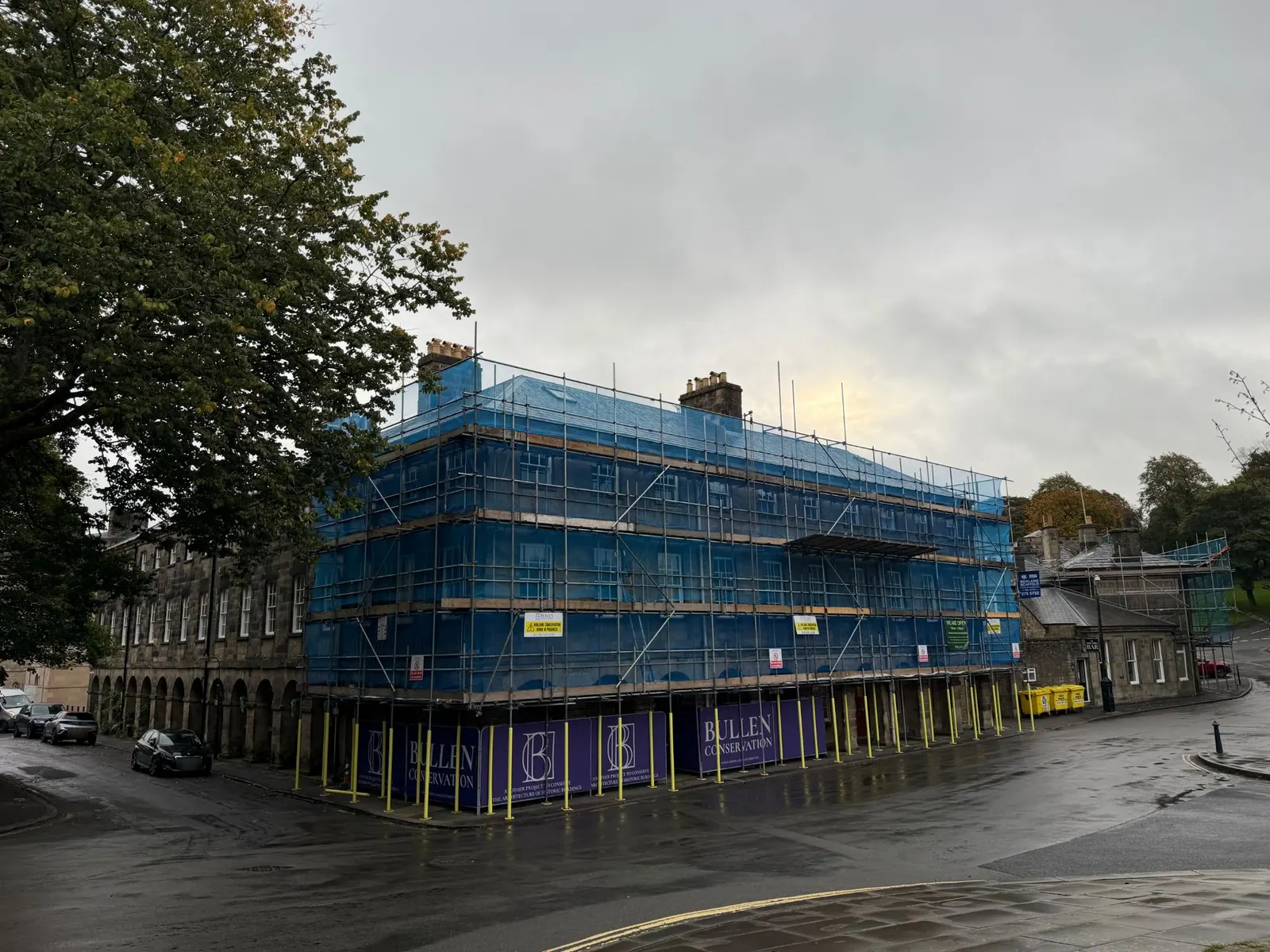
The two properties form the corner of a Grade II* listed Georgian range at the heart of Buxton's historic spa quarter. No 5 belongs to High Peak Theatre Trust, which operates Buxton Opera House, and No 6 is home to The Square Tea Rooms. Our Building Surveying team inspected the building in April 2025, supported by a drone survey of the roof, chimneys and lead-lined cornice gutter. The inspection recorded cracking and displacement of the ashlar, bowing of the front elevation above the arcade, and a failing lath and plaster arcade ceiling.
The investigation established that long-term water ingress from above the string course had decayed the timber wall plate carrying the first floor on the inner arcade wall. Working with a Conservation Accredited Registered Engineer, the repair scheme was designed to deal with that cause rather than the symptoms alone. The decayed wall plate is replaced section by section with gritstone padstones and concealed stainless steel spreader plates, and the first floor is tied back to the external wall with concealed restraint ties and floor straps.
The masonry repairs follow the same principle of minimum intervention. Delaminating ashlar is carefully defrassed and consolidated, cement pointing is raked out and replaced in lime, and cracks are stone-stitched, with the mortar specification informed by laboratory analysis of the historic mortar. Each sash window was inspected from the scaffold, with replacement joinery made to the recorded moulding profiles.
Walker Wood prepared the Heritage Statement, the Design and Access Statement, the Conservation Works Specification and the Schedule of Works, and coordinated the bat survey. The Heritage Statement assessed significance using Historic England's Conservation Principles and set out the justification required under the National Planning Policy Framework and the Planning (Listed Buildings and Conservation Areas) Act 1990. Listed Building Consent was granted by High Peak Borough Council. The works were competitively tendered to specialist conservation contractors, and Bullen Conservation was appointed.
Walker Wood acts as Contract Administrator and as Principal Designer under the Construction (Design and Management) Regulations 2015, administering valuations, instructions and site meetings, and phasing the works so that the Opera House and the Tea Rooms remain in use throughout. Works started on site in September 2026 and completion is programmed for early 2027.
A Brief History of The Square, Buxton
The Square was designed by John White and built between 1803 and 1806 as part of the 5th Duke of Devonshire's programme to establish Buxton as a fashionable spa town to rival Bath. It was conceived as six substantial houses arranged around three sides of a court, unified by a continuous round-arched arcade that links John Carr's Crescent with the Old Hall Hotel. White designed the nearby Church of St John the Baptist over the same period, so the two buildings share both their architect and their date.
The terrace is built in ashlar gritstone beneath a hipped Westmoreland slate roof, with an open ground-floor arcade, a first-floor band and a moulded cornice. It was listed Grade II* in 1951 and stands within a notable group of designated heritage assets, including The Crescent (Grade I), the Opera House and the Old Hall Hotel (both Grade II*).
No 6 has a distinguished association with Dr William Henry Robertson, honorary physician to the Buxton Bath Charity, who lived and practised there from 1861 until his death in 1897. His Guide to the Use of the Buxton Waters ran to 24 editions, and in 1878 he persuaded the 7th Duke of Devonshire to give the Devonshire Stables over to the charity, enabling its conversion into the Devonshire Royal Hospital. The Robertson clock tower on the Devonshire Dome is named in his honour.
Map regression and archival imagery show that the principal elevations of Nos 5 and 6 survive substantially unaltered from the period of construction, which makes careful, like-for-like repair of the original fabric particularly important.
Service on this project
Heritage Surveys and Conservation Services
Walker Wood supports owners, landlords, tenants, developers and trustees with surveys and reports for Listed and historic buildings and other heritage assets. Our approach is evidence-led and proportionate, helping you understand significance, manage risk, and progress consents and investment decisions with confidence.
We advise on whether proposed works are likely to need Listed Building Consent (LBC) and can act as your agent through the application process, coordinating drawings and supporting information so submissions are complete and consistent.
Service on this project
Building Defect Analysis and Defect Diagnosis Surveys
Cracking, movement, damp and decay are symptoms, and a lasting repair depends on identifying the cause behind them. Our defect diagnosis surveys combine close inspection, building pathology and, where required, opening up, laboratory testing and specialist engineering input, so that the remedy addresses the source of the problem.
In historic buildings the diagnosis is of particular importance, because an incorrect diagnosis can lead to unnecessary loss of original fabric or to repairs that fail within a few years.
Service on this project
Contract Administration and Employer’s Agent Services
Walker Wood administers building contracts on behalf of employers, from tender documentation and contractor selection through to practical completion and the end of the rectification period. We administer JCT and other standard forms, certify payments, issue instructions, chair site meetings and manage variations, so that the works are delivered to the agreed quality, cost and programme.
Where required, we act as Principal Designer under the CDM Regulations 2015, giving clients a single point of responsibility for design coordination and health and safety in the pre-construction phase.